There is not an app in the world that can help Gen Z find a date. While marketers try to fill this dating void with apps like Hinge, Grindr, and Bumble, the effect is actually doing the exact opposite. Digital dating is like a warm blanket on the sofa where you think you’re making dating moves when really your just procrastinating going out into the real world and meeting someone.
EL PALMAR, Spain — “The Currents of El Palmar” explores the evolving identity of a small beach town on the Andalusian coast of Spain, where peaceful beaches and steady waves have long drawn surf lovers from around the world. El Palmar has traditionally been a place where families gathered to unwind and immerse themselves in the rhythm of the Atlantic, nurtured by a close-knit surf community that sees the ocean as both teacher and refuge. Local instructor Alex Bartí Jaramillo, a lifelong surfer and resident, embodies that spirit—teaching the next generation of surfers how to ride waves while respecting the coastline and the culture. But El Palmar is changing. As Andalusia experiences record-breaking tourism numbers with more than 33.9 million visitors in 2023, the impact is being felt along even its quieter stretches of coast. International tourism to the region surged by 11% in early 2024, with spending rising over 20%. “It used to be a bit more family-oriented,” Alex reflects, “but now it’s increasingly party-focused. It’s tourism that we don’t like as much.” This documentary captures his frustration as once-peaceful beaches give way to loud nightlife, eroding dunes, and a shifting local economy. Through the story of El Palmar’s surf community, “The Currents of El Palmar” examines how communities can balance welcoming visitors while also preserving the area’s natural essence.
“A college student from rural Louisiana uses her social media to create an unconventional online business, aiming to break free from poverty and help her friends. Her ambition leads her down a risky path as she navigates new challenges.” Is How Rachel Fleit Describes her new film focusing on Autumn, the so called “Robin Hood” of the Louisiana Sugar Babies network. I had the chance to sit down with Rachel and talk about her experience filming in Louisiana.
This post follows the Hands Off protest that took place in Boston Masschusettes on April 5th. An inside look into the purposes and rewards of protesting in public spaces and how people respond to injustice
Does Protesting Work? By Fiona Averill Tuesday, April 8
The TeslaTakedown movement, and the impact of boycotts today
As the political climate shifts rapidly, so too do the ways that we, as civilians, wield our power. The question of how citizens can practice effective activism is a prominent thought in many Americans’ heads, especially when all else seems hopeless.
The #TeslaTakedown movement has been a controversy in the news ever since President Trump made Elon Musk a prominent part of his White House staff. People who are angry about Elon’s presence have taken to the streets.
Elon Musk, who was previously known as a friend to the Democrats, started to become one of President Trump’s most prominent allies starting in 2023. Musk donated a very large amount of money to the Trump campaign, which is where talks of DOGE — the Department of Government Efficiency — started to arise. President Trump has now appointed Musk as the leader of this department.
The reason people are angry is because of two main factors. One, they are upset about the measures that DOGE has taken — for example, the major cuts being made to DEI(Diversity Equity and Inclusion) programs across universities in the country. And two, it is not evident that Musk has the legal grounds to be in this position of power. Musk is officially considered a “special government employee.” However, this position has not been approved by the Senate, creating controversy around his role.
Throughout the country over the last few weeks, people using the #TeslaTakedown tag have spread the word of protests. People have been gathering peacefully in front of Tesla stores in hopes of slowing down business for Musk. One protester, who only identified themself as Eric, said, “Our goal is to voice that this is not okay. We are the guardrails. We are the people. The only thing he understands is money, so we are hoping this gets through to him.”
Heather Jonston, the leader of the grassroots organization that has been protesting the Tesla store in the Back Bay of Boston, said their motive was: “To disrupt sales of Teslas peacefully. Not with property damage or anything like that, but we’re just standing in front of the store and saying like ‘Hey, if you buy a Tesla, you are financially backing Elon Musk, who is right now using his vast wealth to bankroll Republicans who are at fault to support Trump’s extremist agenda.’ So I think the economic impact of this is really powerful right now. A lot of Musk’s Tesla shares are collateral for loans, and the bank can force him to sell those if the value drops. Yeah, so we’re trying to drop the value. But another good part of this, even besides the economic action, is that we’re just like visible in the streets saying we’re not okay with what’s going on, and we hope that more people will join us.”
And more people did join them. On Saturday, April 5, the Tesla protesters, along with many other activist groups in Boston, gathered at the Boston Common for the “Hands Off March.” The protest reportedly had almost 100,000 Bostonians marching from the Boston Common, down Tremont Street to City Hall. There was an array of speakers, including Boston Mayor Michelle Wu and the band the Dropkick Murphys.
Although this protest was a “success” — the large turnout definitely sent a message to the government — the initial controversy of the validity of the Tesla movement continues.
When initial feelings of rage started to arise in concern to Musk being in the Oval Office, there were a few cases of vandalism on Tesla cars. There also was an overwhelming majority of older people at each of the Tesla-related demonstrations around Boston. Younger critics of the movement said there was no use protesting Elon Musk, their reasoning either being he was too rich to be touched or that his place in the White House is legitimate.
“The protesting of Tesla I find to be completely irrelevant. Posting a statement online or sharing conversations with people I feel has more of an impact than standing on the side of the street chanting,” said Sadie Stein, a second-year international finance major at the University of Northeastern.
Joe Worthy, the director of education at the Albert Einstein Institution — an organization that helps with peaceful protests — helps to shape how activism truly becomes effective: “By starting here (at the bottom of the pyramid depicted below), understanding your situation, you can develop a branch strategy. How and when are you going to engage, right? Like how many people do you need to recruit? And then you can engage in a more limited strategy. This is kind of like the stepping stones to get to your ultimate end.”
In such a digital world, it is all the harder to get people onto the streets. However, the impact that it makes is incomparable to other forms of resistance. Doubters who say smaller protesters are wasting their time fail to recognize that all movements have to start somewhere.
In this example in particular, it is evident that their cause grew. The grassroots leaders of the Back Bay #TeslaTakedown movement joined together with a plethora of other causes this past weekend at the “Hands Off” protest. Tesla stock has dropped 44% since January, according to CNN reporter Chris Idifore.
Although the political landscape is as rocky as ever, what remains true is the power of the people. The act of protest has been instrumental to the civil rights movement, the gay rights movement — even tracing back to the Revolutionary War. Protest is how change was made. The #TeslaTakedown movement, however small it started, has certainly made a dent in American history.
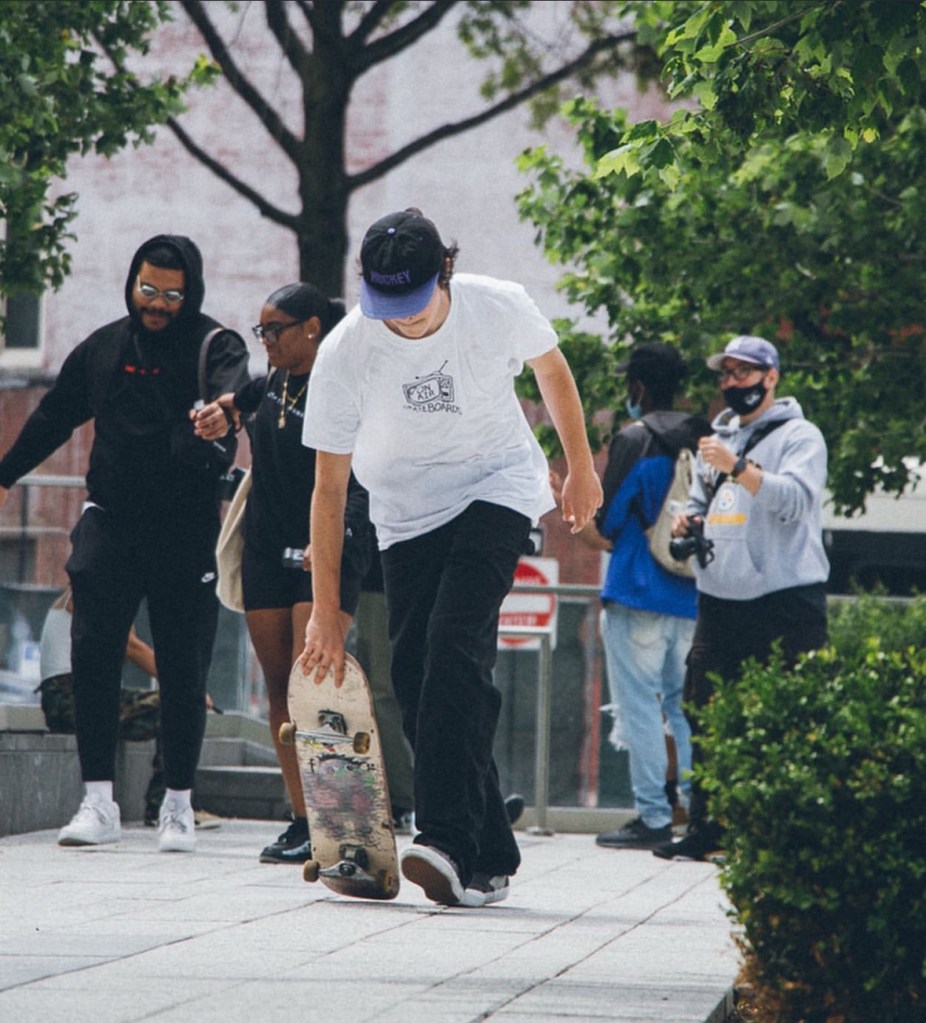
Iden Ottmann Launched “On Air Skateboards” during the global pandemic, turning a challenging time into an opportunity for success. Reflecting on the company’s beginnings, Ottmann shares how he built a community amid widespread isolation and how it paved the way for his success today.Ottmann is a second year Engineering and Design student at the University of Northeastern. Iden grew up in Brooklyn, New York where he and his friends were immersed in the NYC “Skate Scene”. Through the COVID- 19 pandemic Ottmann created a brand called ‘On Air Skateboards. As he grew up with the company they both have taken on many new forms.
Entrepreneur Q&A
Iden Ottmann launched On Air Skateboards during the global pandemic, turning a challenging time into an opportunity for success
Reflecting on the company’s beginnings, Ottmann shares how he built a community amid widespread isolation and how it paved the way for his success today.
By Fiona Averill Staff,Updated February 9, 2025, 4:00 p.m.
BOSTON – Iden Ottmann is a second year Engineering and Design student at the University of Northeastern. Iden grew up in Brooklyn, New York where he and his friends were immersed in the NYC “Skate Scene”. Through the COVID- 19 pandemic Ottmann created a brand called ‘On Air Skateboards. As he grew up with the company they both have taken on many new forms.
Q: What is On Air Skateboards?
Ottmann:So I started on air over COVID, really, as a creative outlet for myself, and started it through the lens of skateboarding, my hobby and passion at the time and through it, created clothing and other productions videos of us skateboarding so it came from two places. One, my love for art and sort of a way to monetize that through clothing. And the other part of that was skateboarding, which was something that meant a lot to me and my friends as it’s what we spent our time together doing. So for me, this company was a way of empowering my community, my friends, to spend time on the things that we loved and spend time together.
Q: What was it like trying to find community during Covid times?
Ottmann: It was sort of a way for me and my friends to be excited about something during a time where we couldn’t necessarily be together, and as we started to be able to see each other more, as lockdown lifted, it really evolved into just something that forced us to spend time together. It was pretty organized. We did a lot of films, short videos on our skateboarding done by my good friend Tobi, who sort of started the company with me. And they were very organized. We always had direct meeting times and had a plan of the tricks we wanted and the shots we wanted, but the rest was very impromptu. I think that was one of the best things about it, is how the community we had expanded just through meeting new friends at skate spots and skate parks and clothing events.
Q: How did On Air help you be a part of the urban community and learn about the skating culture of NYC?
Ottmann: I definitely knew it from the outside quite well, growing up around it and being into skateboarding, but the New York City skateboarding culture is a fairly rigorous world, and people are very serious about what they do. So we learned pretty quick that, you know, if we wanted to sort of be taken seriously, we had to, well, nothing was taken seriously, but we had to take ourselves kind of seriously. If we wanted to reflect actual brand values, we couldn’t just be a group of kids who hung out. We had to create a website and sell clothing and throw events and you. Hmm, things like that, which again grew our community, our crew, but also grew our understanding of the way skateboarding, the world of it worked in New York City.
Q: How did you and the founding members collaborate?
Ottmann: It was me and my good friend Toby, primarily, where I did the clothing design, the artwork, and he did the film work. And together, we sort of combined our talents and our interests to create something that could be cool. We combined our interests to be able to explore them in a more professional way, in a way that could, you know, reflect, yeah, further in the future than just practicing for the fun of it.
Q: How have the careers and lives of the founding members evolved into adulthood? Has On Air helped your personal development?
Ottmann: Yes, it really has. I mean, Toby, who did the film work. He isn’t in college anymore. He chose to drop out and just do film full time, independently. And you know, he’s made it work for almost a year now, so that’s really cool to see him follow that passion that sort of was very early, explored very early on, in the context of on air. I And then, you know, we had other members, Milo, he did some art with us, always skated with us, and he’s doing architecture now. And you know, another continuation of someone’s creative exploration. I’m a combined major in mechanical engineering and design, which I also feel comes from those roots that definitely the design part with, you know, clothing design, t – shirt design, graphic design, but even the mechanical engineering to very you know, problem solving, I feel like a lot of the engineering values are fairly strong in entrepreneurship of problem solving and more in creativity, in a more confined space than just art or just creatively.
Q: Where is On Air now? Well,so over COVID, the first thing I did was, I got a lawyer and and filed my company on air skateboards as an LLC, because from that initial vision was we really wanted to sell clothes and be a clothing brand, but it definitely grew past the clothing pretty quickly and really turned into a way for me to be able to share clothing. You know, I’d give it to a lot of my friends. I’d sell enough to make back what I spent and give the rest away. Me or so, like, your gang all had like, the same kind of shirt, like, which is kind of cool, yeah, and it was, it was fun. I remember the first time I saw someone that I didn’t know on the subway in New York wearing one of my hats. And it was shocking, yeah, and it was really but it was really cool to see that, you know, other people liked it. I went up and, you know, I couldn’t believe it. Yeah, he told me it was one of his favorite hats. And saw an Instagram ad we put up for it. We definitely sold quite a few things to, you know, people we didn’t know, mostly at events, in person, but some online. I’m glad I started it younger, when there was less pressure to have it be successful. It was a lot less, because now it sort of can sit in the background while I’m here and doing college, but it’ll be there for me to be able to pick up when I want to, and it’ll definitely be something that I come back to in the future.


 Fiona Averill